How Much Protein Do You Actually Need?
The official protein number is often called "too low" and just as often misread. Here is what the RDA actually defines, why some researchers read it differently, and the one effect of protein the trials agree on.
By MetabolicFoods Editorial Team
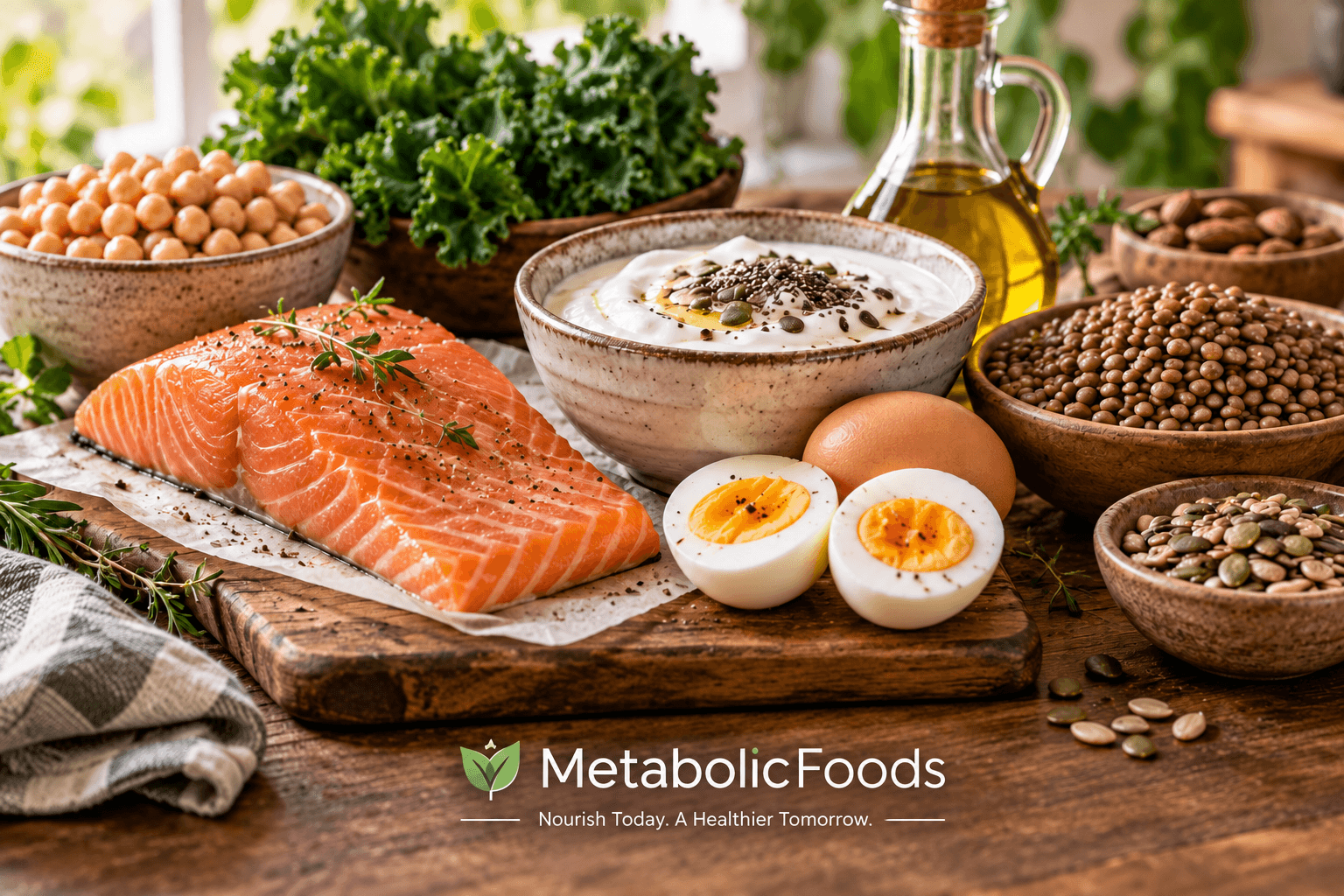
Protein has a strange public life. Officially, there is a number: a recommended daily allowance that has barely changed in decades. Unofficially, there is a much louder conversation in which that number is dismissed as far too low, and in which the "right" amount seems to rise every year. Both sides quote figures with confidence. This article tries to explain what the official number actually means, what the wider recommended range is, and what the research says about one thing protein reliably does: keep you feeling full.
What "RDA" actually means
The Recommended Dietary Allowance is set by the Food and Nutrition Board of the National Academies of Sciences, Engineering, and Medicine. Its definition is precise, and worth quoting in full: the RDA is "the average daily dietary intake level that is sufficient to meet the nutrient requirement of nearly all (97 to 98 percent) healthy individuals in a particular gender and life stage group."
Read slowly, that definition corrects a common misunderstanding. The RDA is not a bare minimum. It is deliberately set above what the average person requires, so that it covers nearly everyone in a group, including people whose needs are higher than typical. Someone meeting the RDA is, by design, very likely to be meeting their requirement.
The protein RDA
For adults, the protein RDA is 0.8 grams per kilogram of body weight per day, and it has been essentially unchanged for more than seventy years. For a 70-kilogram adult, that works out to about 56 grams of protein a day; for a 60-kilogram adult, about 48 grams. These are simple multiplications of the RDA by body weight, not separate recommendations.
Why some researchers read it differently
Here the debate begins, and it deserves a fair hearing rather than a verdict. In a 2017 review in Advances in Nutrition, Wolfe and colleagues argue that the protein RDA was, in practice, derived from nitrogen-balance studies: research designed to estimate the minimum amount of protein needed to avoid a loss of body nitrogen. On that basis, they contend, the figure should not be read as an optimal target.
That is their interpretation, and we present it as such. It does not contradict the official definition; it is an argument about how the underlying research was done and what it can and cannot tell us.
A second framework: the AMDR
Alongside the RDA there is a second reference, the Acceptable Macronutrient Distribution Range, or AMDR. For protein, the AMDR is 10 to 35 percent of total energy intake, while the adult RDA is expressed as 0.8 grams per kilogram of body weight per day.
It is tempting to compare the two directly, and the comparison is often made carelessly. These are different reference frameworks and should not be treated as directly interchangeable without considering individual energy needs. One is a share of the energy a person eats; the other is tied to how much that person weighs. How they relate depends on the individual, so a blanket statement about which is "higher" is not something the sources support.
The same 2017 review notes that studies, particularly in older adults, have examined protein intakes that exceed the RDA. That is as far as the source goes, and as far as this article goes. It is not a settled recommendation for the general population.
What protein does for fullness
If the question of "how much" carries some uncertainty, one effect of protein is comparatively well documented. A 2020 systematic review and meta-analysis of randomized controlled trials by Kohanmoo and colleagues found that protein intake reduced hunger and increased fullness in the hours after eating, alongside changes in appetite-related hormones.
Because this comes from pooled controlled trials rather than observation, it speaks more directly to cause and effect. It is also a modest, practical finding: a meal with protein in it tends to keep you satisfied for longer. That is one reason many people find protein-containing meals easier to live with, and it needs no grand claim attached to be useful.
A food-first way to think about it
None of this settles the loud online debate, and it is not meant to. What it offers is a calmer starting point.
The RDA is a well-defined reference intake designed to meet the needs of nearly all healthy adults in a given group. Some researchers argue it understates what is optimal, and studies have examined higher intakes, particularly in older adults. The AMDR offers a range, but it is a different kind of measure and cannot simply be laid over the RDA. And protein reliably helps with fullness.
In practice, that argues for building meals around whole foods that contain protein rather than chasing a precise gram count. Our Slow-Roasted Salmon with Fennel, for instance, provides about 37 grams of protein per serving, calculated from USDA FoodData Central data for its listed ingredients; our Berry & Chia Overnight Oats comes to about 18 grams by the same method. Those figures are estimates and will vary with brands and substitutions, but they show how ordinary meals add up. The High Protein category on this site collects more, each with a nutrition panel you can check for yourself.
What this article deliberately leaves out is worth naming. How to spread protein across the day, targets for athletes or for building muscle, and anything to do with weight loss are separate questions with their own bodies of evidence. They deserve careful treatment of their own rather than a passing mention here.
Sources
- Optimizing Protein Intake in Adults: Interpretation and Application of the Recommended Dietary Allowance Compared with the Acceptable Macronutrient Distribution RangeAdvances in NutritionMarch 15, 2017Verified
- Introduction to Dietary Reference Intakes (Dietary Reference Intakes for Vitamin C, Vitamin E, Selenium, and Carotenoids)National Academies Press, via NCBI BookshelfVerified
- USDA FoodData CentralU.S. Department of AgricultureVerified
- Effect of short- and long-term protein consumption on appetite and appetite-regulating gastrointestinal hormones, a systematic review and meta-analysis of randomized controlled trialsPhysiology & BehaviorAugust 5, 2020Verified
Continue reading
Protein at Breakfast: How Much Do You Really Need?
Total daily protein and per-meal protein are two different questions. Here is what the research on muscle protein synthesis says about the second one, and what it looks like on a plate.
What Is Resistant Starch? Foods, Benefits, and How It Works
Resistant starch is the portion of starch that skips digestion in the small intestine. Here is how it is classified, what the research links to it, and where it shows up in ordinary food.
How to Build a Lower-Glycemic Meal
Glycemic index describes individual foods. Here is what the research says about how combining and sequencing foods within a meal changes the outcome.