Soluble vs. Insoluble Fiber: What's the Difference?
Fiber is often discussed as two broad types. Here is what soluble and insoluble actually describe, what current research links to each, and why the field has moved past a simple binary.
By MetabolicFoods Editorial Team
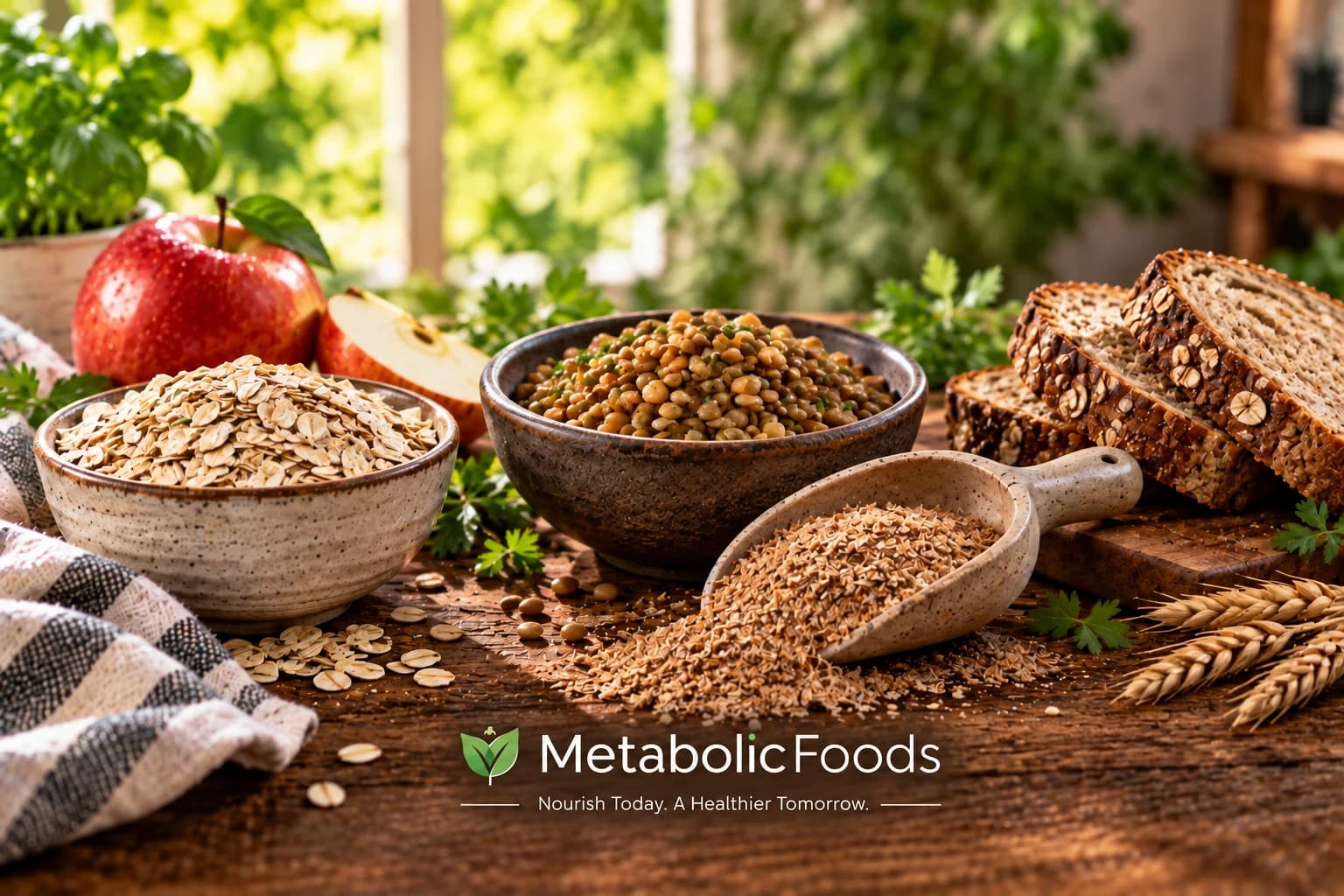
Fiber is usually presented as one thing, but nutrition writing and research routinely split it into two: soluble and insoluble. The distinction is real, it's decades old, and it's more limited than it's often made out to be. Here's what the terms actually describe, what's generally associated with each, and where the classification itself runs into trouble.
What the two terms describe
Fiber is often discussed as two broad types: soluble and insoluble. Soluble fiber dissolves in water; insoluble fiber does not — that's the basic, literal distinction behind the two terms. In whole foods, soluble fiber is concentrated in oats, beans, lentils, apples, and citrus fruit, among others. Insoluble fiber is concentrated in wheat bran, the skins of many fruits and vegetables, and whole grains generally. Most fiber-containing foods have some of both. U.S. Nutrition Facts labels are required to list Total Dietary Fiber as a single number; they don't routinely break that total down into soluble and insoluble amounts, so this split is a distinction you'll see in nutrition science and research, not something spelled out on most packages.
Soluble fiber's most-cited property is that some forms of it become viscous, or gel-like, in the digestive tract. Insoluble fiber's most-cited property is that it adds bulk to stool and is associated with more regular bowel movements. Both are widely repeated, and both are reasonable starting points — but the research over the past several years has complicated the picture in an important way.
Why the field has moved past a simple binary
A 2023 review in Nutrients, led by fiber researcher Joanne Slavin at the University of Minnesota, makes a specific and useful point: the idea that solubility alone explains a fiber's physiological effects was introduced in the 1970s, and it's no longer considered an adequate explanation. The review argues that a fiber's real-world effects have more to do with its viscosity and how fermentable it is by gut bacteria than with whether it technically dissolves in water. Two soluble fibers can behave very differently in the body depending on those properties, and the same is true of two insoluble fibers.
That doesn't make the soluble/insoluble split useless — it's still how fiber is measured and labeled, and it's still a reasonable rough guide. But it's worth knowing that nutrition science itself treats the binary as a simplification, not a precise mechanism.
What the evidence says about soluble, viscous fiber
Where the soluble/insoluble distinction does hold up reasonably well is with a specific subset: viscous soluble fibers, the ones that form a gel. A 2017 systematic review and meta-analysis in the American Journal of Clinical Nutrition looked specifically at konjac glucomannan, a viscous soluble fiber, across randomized controlled trials, and found it lowered LDL cholesterol by an average of about 10% and non-HDL cholesterol by about 7%. This is evidence for one specific viscous fiber, not a blanket claim that all soluble fiber lowers cholesterol — the effect is tied to the gel-forming property the newer research points to, not to solubility on its own.
What the evidence says about insoluble fiber
The same 2023 Nutrients review also pushes back on a common assumption: that insoluble fiber mainly just adds bulk. It notes that insoluble fiber intake has been linked to a range of health associations beyond stool weight, and argues that isolating fiber from the other plant compounds it travels with in whole foods — polyphenols and other bioactives — may understate its role. This is a research argument, not a settled finding, and the review is explicit that more targeted study is still needed.
The practical takeaway
For everyday eating, the soluble/insoluble label is still a useful shorthand, and there's no need to track the two separately. Whole foods that are high in fiber generally contain both. The more useful habit is the one this site returns to across its fiber content: think in terms of whole meals built around legumes, whole grains, vegetables, and fruit, rather than trying to hit a soluble or insoluble target directly. Our High-Fiber Lentil & Greens Bowl and Chickpea Quinoa Crunch Salad are both built this way, combining several plant sources rather than isolating a single type of fiber.
The short version
Soluble fiber dissolves in water and is concentrated in oats, legumes, and fruit; insoluble fiber does not dissolve and is concentrated in bran, skins, and whole grains. The classic associations — soluble with gel-forming and cholesterol effects, insoluble with bulk and regularity — are reasonable starting points, but current research treats a fiber's viscosity and fermentability as better explanations for its effects than solubility alone. A 2017 meta-analysis found a specific viscous soluble fiber lowered LDL cholesterol by about 10%; that's evidence for that fiber, not for "soluble fiber" as a category. For most people, eating a variety of whole plant foods does more than trying to sort fiber into two bins.
Sources
- A systematic review and meta-analysis of RCTs of the effect of konjac glucomannan, a viscous soluble fiber, on LDL cholesterol and the new lipid targets non-HDL cholesterol and apolipoprotein BAmerican Journal of Clinical NutritionMarch 29, 2017Verified
- USDA FoodData CentralU.S. Department of AgricultureVerified
- Beyond Insoluble Dietary Fiber: Bioactive Compounds in Plant FoodsNutrientsSeptember 25, 2023Verified
Continue reading
What Is Resistant Starch? Foods, Benefits, and How It Works
Resistant starch is the portion of starch that skips digestion in the small intestine. Here is how it is classified, what the research links to it, and where it shows up in ordinary food.

How Much Fiber Do You Really Need?
Fiber is recommended everywhere and explained almost nowhere. Here is what a major 2019 review found, what "association" really means, and how two ordinary meals get you most of the way.

How to Build a Lower-Glycemic Meal
Glycemic index describes individual foods. Here is what the research says about how combining and sequencing foods within a meal changes the outcome.